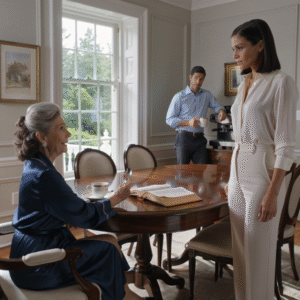
“Mom, we need to talk.”
Those five words, spoken by my own son, David, just three weeks after we buried his father, shattered what little piece of me I had left. I was still wearing Robert’s old sweater, still sleeping on his side of the bed because mine felt too cold, too empty.
The scent of his cologne lingered on the fabric, the only comfort I had in this house that suddenly felt like a mausoleum. David stood in our living room doorway, his wife Jessica beside him with that practiced smile she wore to charity galas, the same smile she’d given me at the funeral while calculating, I’m sure, how quickly they could clear out forty-five years of my life.
“Of course, sweetheart.
Sit down.”
I gestured to the couch where Robert and I had watched countless Sunday football games, where we’d held David as a colicky baby, where we’d celebrated every Christmas morning for decades. Jessica perched on the edge like she was afraid the fabric might contaminate her designer dress.
David couldn’t even look me in the eye.
“Mom, this house is too big for you now.”
His voice carried that condescending tone he’d perfected in corporate boardrooms.
“It’s not practical. The maintenance, the property taxes, the upkeep.
It’s too much for someone your age.”
As if sixty-eight meant I was one foot in the grave.
“Jessica and I have been looking at some lovely senior communities. Sunrise Manor has a beautiful facility in White Plains, much more appropriate for your situation.”
My situation. Widowed.
Alone. Disposable.
“What David means,” Jessica interrupted, her voice dripping with false sweetness, “is that we’re concerned about you rattling around in this big house all by yourself. It’s not safe.
What if you fell? What if something happened?”
I watched them. These two people I’d fed at my table for fifteen years, whom I’d babysat for when their careers demanded weekend trips to the Hamptons—the same Hamptons where Jessica posted Instagram photos of champagne brunches while I stayed home with Emma and Lucas, reading them bedtime stories and teaching them to bake chocolate chip cookies.
“We’ve already contacted a realtor,” David continued, pulling out his phone like he was reading a grocery list.
“The market’s hot right now. We could get close to 2.8 million, maybe three.”
“After we settle Dad’s debts and handle the estate taxes, there should be enough left for a nice apartment at Sunrise Manor, and maybe a little nest egg.”
A little nest egg from the sale of the home where I’d raised him, nursed him through chickenpox, celebrated his high school graduation, danced at his wedding reception in our backyard.
“We’ve already put down a deposit,” Jessica added, unable to contain her excitement. “There’s a lovely one-bedroom available next month.
It has a kitchenette and everything.”
A kitchenette for the woman who’d hosted Thanksgiving for twenty-three people last year.
I felt something crack inside my chest. But it wasn’t my heart breaking. It was something harder, something that had been building strength in silence for forty-five years of putting everyone else first.
“You’ve already put down a deposit,” I repeated slowly.
“Don’t worry about the money, Mom.
We’ll handle everything. The paperwork, the moving company, sorting through Dad’s things. You don’t need to stress about any of it.”
Dad’s things.
As if Robert’s entire life could be reduced to items for donation bags.
I stood up slowly, my hands surprisingly steady.
“Get out.”
“Mom, don’t be dramatic.”
“Get out of my house.”
My voice was quiet, but something in it made David’s mouth snap shut.
Jessica’s façade cracked.
“Margaret, you’re obviously still grieving. You’re not thinking clearly.”
“I said, get out.”
I walked to the front door and opened it wide.
“And David, don’t come back until you remember who raised you.”
As they stumbled toward their BMW—Jessica hissing something about ungrateful and senile—I closed the door and leaned against it. Tomorrow, I would make a phone call that would change everything.
But tonight, I would mourn, not just for Robert, but for the son I thought I knew.
If you’re listening to this story, please subscribe to our channel and let me know in the comments where you’re watching from.
I have a feeling you’re going to want to hear what happens next.
What they didn’t know was that Robert had been planning for this exact moment for years.
The morning after David’s ultimatum, I sat in Robert’s study, surrounded by his law books and the faint smell of his pipe tobacco. My hands shook as I dialed the number I’d found in his personal phone book, written in his careful handwriting.
Henry Morrison. Call if Margaret needs anything.
I’d never heard Robert mention Henry Morrison.
Morrison and Associates.
A crisp voice answered.
“This is Margaret Thompson.
My husband Robert passed three weeks ago, and I found your number.”
“Mrs. Thompson.”
The voice immediately warmed.
“I’ve been expecting your call. Please hold on one moment.”
Expecting my call.
“Mrs.
Thompson. This is Henry Morrison. First, please accept my deepest condolences.
Robert was not just a client. He was a dear friend.”
“I’m sure this is overwhelming, but he left very specific instructions.”
My heart hammered against my ribs.
“Instructions?”
“Can you come to my office this afternoon? There are documents he wanted you to see personally.
Documents that… well, let’s just say they might change your current situation considerably.”
Two hours later, I sat across from Henry Morrison in his Manhattan office, a distinguished man in his sixties with kind eyes and expensive suits. Between us lay a manila envelope with my name written in Robert’s handwriting.
“Before we begin,” Henry said, “Robert made me promise to ask you one question. He said you’d understand.”
“Does she remember what I told her about the lighthouse?”
“The lighthouse?”
I gasped, my hand flying to my throat.
Our second anniversary, Robert had driven me to Montauk Point.
We’d climbed to the top of the lighthouse, and he’d said:
“Maggie, promise me something. No matter what happens, no matter who tries to dim your light, remember that you’re stronger than you know, and I’ll always make sure you have everything you need to shine.”
I’d laughed and called him a romantic fool.
“Yes,” I whispered. “I remember.”
Henry smiled and slid the envelope across the desk.
“Then this is yours.”
Inside were documents that made my hands tremble.
A trust fund worth $12.8 million. Stocks, bonds, investment accounts I’d never known existed. And a property deed for 847 Ocean Road, East Hampton, New York.
“Robert purchased the Hampton house eighteen months ago,” Henry explained.
“He said he wanted to make sure you’d always have a place to call home, no matter what happened. The house is worth approximately $8.2 million, fully furnished, and it’s yours outright. No mortgage.
No liens.”
I stared at the papers, unable to process what I was seeing.
“But how? Robert’s business… I thought we were comfortable, but not…”
“Your husband was a very shrewd investor, Mrs. Thompson.
He started planning for your security the day David got married. He said, and I quote, ‘I love my son, but I know Jessica. If something happens to me, Margaret will need to be protected.’”
He knew.
He suspected David might prioritize other interests over your welfare. Robert made sure that would never be a problem.
Henry leaned forward.
“There’s more. The trust has specific provisions.
If anyone attempts to manipulate, coerce, or financially abuse you, the trust activates additional protective measures.”
I thought about David’s casual mention of estate debts, his certainty that there would be maybe a little nest egg left over.
“What kind of protective measures?”
Henry’s smile was sharp.
“Let’s just say Robert was very thorough. He documented everything. Every family dinner conversation, every comment Jessica made about inheritances.
Every time David mentioned what he’d do when the time came, he recorded them.”
“Your husband was dying, Mrs. Thompson. He had months to observe and prepare.
He knew exactly what would happen after his funeral.”
I sat back, overwhelmed. Robert had been three steps ahead while I’d been grieving, protecting me even from the grave.
“There’s one more thing,” Henry said, sliding another document across the desk. “He left you a letter.”
With shaking fingers, I opened the envelope marked For my Maggie.
“If you’re reading this, then David has shown his true colors.
Don’t cry, my love. Get angry. You spent forty-five years being the perfect wife and mother.
Now it’s time to be the woman I always knew you were. Fierce, independent, and unstoppable.”
“The Hampton house has everything you need. The key is with Morrison.
Go there today. Start your new life.”
“And Maggie, make them remember who they’re dealing with.”
“All my love, Robert.”
I looked up at Henry through tears that weren’t of sadness anymore.
“Can you drive me to the Hamptons?”
But first, I had a phone call to make.
I dialed David’s number from Henry’s office, my voice steady as steel.
“Mom, look, about yesterday… Jessica thinks maybe we were too direct.”
“David, I’ve been thinking about what you said. You’re right.
This house is too big for me.”
Silence.
Then, “Oh… well, that’s… that’s good, Mom. Very practical.”
“I’ll need help packing Robert’s things. Can you and Jessica come by tomorrow around noon?
I want to go through everything together as a family.”
“Of course. Jessica will be so relieved. She was worried you’d be stubborn about this.”
Stubborn.
Like wanting to keep my home of forty-five years was unreasonable.
“Oh, and David—invite Jessica’s parents too. And your Uncle Frank. I want everyone to see how generous you’re being with your poor old mother.”
“Mom, you don’t sound like yourself.”
“I’m just tired, sweetheart.
Tomorrow we’ll sort everything out.”
Henry drove me to East Hampton that afternoon. As we turned onto Ocean Road, my breath caught. The house was magnificent—a sprawling gray-shingled mansion with white trim, wraparound porches, and gardens that rolled down to a private beach.
It looked like something from a magazine, the kind of place Jessica posted about on Instagram when she visited her wealthy friends.
“Robert chose well,” Henry said, handing me the keys.
“He spent months finding the perfect place.”
Inside, the house was even more stunning. Floor-to-ceiling windows overlooked the ocean. Furniture covered in white linens looked like it had never been touched, and fresh flowers sat in crystal vases on every table.
“The housekeeper, Maria, has been maintaining it,” Henry explained.
“Robert arranged for full staff—gardener, housekeeper, even a chef if you want. All prepaid for the next five years.”
In the master bedroom, I found another envelope on the nightstand. Inside was a photograph of Robert and me from our honeymoon in Cape Cod.
And another note.
“Welcome home, Maggie. This is where you were always meant to be. By the ocean, in the light, free to be yourself.”
“Tomorrow, when they see what they’ve lost, remember you don’t owe them anything.
But if you choose to forgive, make sure they’ve earned it.”
“P.S. Check the closet.”
The walk-in closet held more surprises: designer clothes in my exact size, tags still attached. Shoes, handbags, jewelry—everything I’d admired in magazines but never bought because we needed to be practical.
Robert had been planning this sanctuary for months.
That night, I sat on the deck watching waves crash against the shore, sipping wine from a crystal glass, wearing a cashmere robe that cost more than my monthly grocery budget.
For the first time in weeks, I felt like I could breathe.
But tomorrow would be the real test.
The next morning, I drove back to Westchester in Robert’s old Honda, the car David assumed would be sold along with everything else. I arrived at 11:30 and began my performance.
I was in the kitchen wearing my oldest dress and an apron when they arrived. David, Jessica, her parents—Barbara and Richard Wellington—and Uncle Frank filed into my living room like vultures circling prey.
“Margaret, dear,” Barbara Wellington cooed.
“David told us about your decision. So wise to downsize at your age.”
Jessica was practically vibrating with excitement, her eyes scanning the antique furniture and oil paintings.
“We brought boxes,” she announced. “I thought we could start with the valuable pieces.”
“Of course,” I said meekly.
“I’m just so grateful David is handling everything. I wouldn’t know where to begin.”
I watched Jessica make a mental inventory: the Waterford crystal, the Persian rugs, the grandfather clock Robert had inherited from his father. She was already redecorating in her mind.
“Now, Mom,” David said, settling into Robert’s favorite chair, “we need to discuss finances.
Dad’s business had some debts, and the estate taxes will be significant. We’ll need to sell quickly to cover everything.”
“Debts?”
I let my voice quaver.
“But I thought Robert always said we were secure.”
“Dad was protecting you from the harsh realities,” David explained patronizingly. “That’s what husbands do.
But don’t worry—Jessica and I will handle everything. You won’t need to think about money at all.”
Uncle Frank shifted uncomfortably. He’d known Robert longer than anyone.
“The realtor thinks we can get three million,” Jessica chimed in.
“After expenses, there should be enough for your apartment and maybe fifty thousand left over.”
Fifty thousand from a three-million-dollar house and forty-five years of marriage.
“That sounds very generous,” I whispered.
“We’re family,” David said magnanimously. “We take care of each other.”
I excused myself to get coffee and called Henry from the kitchen.
“It’s time,” I said quietly.
“Are you sure?”
I watched through the doorway as Jessica held up my grandmother’s china, examining it like merchandise.
“I’m sure.”
The doorbell rang at exactly 1:00 p.m.
“I’ll get it,” I said, smoothing my apron with trembling hands—though not from fear anymore.
Henry Morrison stood on my doorstep with two other men in expensive suits and a woman carrying a briefcase. Behind them was a black sedan that screamed money and power.
“Mrs.
Thompson,” Henry said formally, “we’re here for the estate consultation you requested.”
“Estate consultation?”
David’s voice cracked from the living room.
I led them inside, watching Jessica’s face drain of color as she recognized the type of lawyers who charged $500 an hour just to breathe.
“Everyone, this is Henry Morrison—Robert’s attorney—and his associates from Morrison and Associates in Manhattan.”
Barbara Wellington nearly choked on her coffee. Morrison and Associates was the law firm that handled the Kennedys.
“I’m sorry,” David stammered, “but we weren’t expecting—Mom, you didn’t mention—”
“Robert left specific instructions,” Henry interrupted, setting his briefcase on the coffee table with deliberate precision. “Instructions that could only be executed after certain circumstances became clear.”
The woman, introduced as Patricia Chen, forensic accountant, began pulling documents from her briefcase while the two other lawyers flanked the room like sentries.
“Mrs.
Thompson,” Henry continued, “your husband was very thorough in his final wishes. He documented several concerns about potential irregularities regarding his estate.”
Jessica gripped David’s arm.
“What kind of irregularities?”
“Let’s start with the obvious,” Patricia Chen said, consulting her tablet. “Mr.
David Thompson, you mentioned estate debts and significant taxes. Could you provide documentation of these debts?”
David’s mouth opened and closed like a fish.
“Well, I… I assumed—”
“You assumed?”
Henry repeated.
“Based on what evidence?”
“Business debt, estate taxes, funeral costs…”
David’s voice grew smaller with each word.
“Mr. Robert Thompson’s business had zero debt,” Patricia announced.
“His life insurance policy of $2.2 million covered all funeral expenses, with $1.9 million remaining. Estate taxes, due to careful pre-planning, amount to approximately $340,000.”
The room fell silent except for the grandfather clock ticking.
“Furthermore,” Henry continued, “Mr. Thompson documented several interesting conversations.”
He pressed play on a small device.
Robert’s voice filled the room, clear as day.
“Margaret, could you get me some water?
My throat’s dry.”
Then Jessica’s voice.
“When this is all over, we’ll finally be able to renovate the kitchen in our place. This house will sell for at least three million.”
David’s voice followed.
“Mom won’t need much. Senior living is cheap, and she’s never been good with money anyway.”
Jessica looked like she’d been slapped.
“That was a private conversation.”
“In a dying man’s home,” Henry said coldly, “a man who was very much aware of what was being said around him.”
Uncle Frank shifted forward.
“Wait a minute.
Robert never mentioned any debt to me, and I handled his books for thirty years.”
“Because there wasn’t any,” Patricia confirmed. “Mr. Thompson’s estate is worth approximately $18.7 million in liquid assets, plus properties valued at an additional $12.3 million.”
Barbara Wellington dropped her coffee cup.
It shattered on the hardwood floor Robert had refinished himself twenty years ago.
“Thirty-one million,” David whispered.
“But here’s the interesting part,” Henry smiled, and it wasn’t pleasant. “Mr. Thompson restructured his entire estate six months before his death.
The family home, all joint accounts, and the majority of liquid assets were transferred into an irrevocable trust.”
Jessica found her voice.
“A trust? What kind of trust?”
“The Margaret Thompson Survivors Trust,” Patricia announced, “with Mrs. Thompson as the sole beneficiary and trustee.”
I watched the greed drain from Jessica’s face, replaced by something close to panic.
“That’s impossible,” she breathed.
“Marital assets can’t just be transferred.”
“They can when both spouses signed the documents,” Henry said, producing papers with Robert’s signature and mine. “Mrs. Thompson signed these documents three months ago.”
David stared at me.
“You knew?
You knew and you let us—”
“Let you what, David?” I asked quietly. “Let you show me exactly who you’ve become.”
Jessica lurched to her feet.
“This is fraud. She manipulated a dying man.”
“Actually,” Patricia said, consulting her notes, “we have video documentation of every signature along with cognitive assessments proving Mr.
Thompson was of completely sound mind.”
Henry nodded.
“Your husband was dying, Mrs. Thompson, but his mind was sharp until the very end. He wanted to see how his family would treat you when they thought you were vulnerable and alone.”
The room spun around David like a tornado.
“So you have everything?”
“Not everything,” I said, standing up and untying my apron.
“I have what Robert wanted me to have—what he spent forty-five years working to give me.”
Jessica’s voice was pure venom.
“You scheming old…”
“Watch yourself,” Uncle Frank warned, standing up. His voice carried the authority of a man who’d built half the buildings in Westchester County.
I walked to the window and looked out at the garden where Robert and I had planted roses on our tenth anniversary.
“David, do you remember what your father used to say about respect?”
“Mom, please—let’s talk about this rationally.”
“He used to say that respect isn’t something you inherit. It’s something you earn every single day.”
I turned back to face them all.
“Well, congratulations.
You’ve all earned exactly what you deserve.”
But I wasn’t done with them yet.
“Henry, could you please show them the Hampton property documents?”
Jessica’s face went from pale to green.
“Hampton property?”
Henry spread photographs across the coffee table like he was dealing cards in a high-stakes poker game. Aerial shots of a magnificent oceanfront estate. Professional interior photos showcasing rooms that belonged in Architectural Digest.
“847 Ocean Road, East Hampton,” Henry announced.
“Purchased eighteen months ago for $8.2 million, currently valued at $9.1 million.”
Barbara Wellington leaned forward, squinting at the photos.
“Wait… is that the Morrison estate? The one that was featured in Town & Country?”
“The very same,” I confirmed. “Robert bought it from the Morrison family last year.”
“Different Morrisons,” I added with a small smile toward Henry.
Jessica grabbed one of the photos, her hands shaking.
“This is where you’ve been living since yesterday?”
“Yes.
It’s quite comfortable. The ocean view from the master bedroom is spectacular.”
David looked like he’d been hit by a truck.
“You’ve been… you’ve been staying in the Hamptons while we thought you were here crying into your tea.”
“I was never much of a tea person,” I said, “though the house does have an excellent wine cellar. Robert stocked it with bottles older than your marriage.”
Jessica’s voice was a strangled whisper.
“The Hampton house is worth more than our apartment, our cars, and David’s 401(k) combined.”
“Interesting perspective,” I mused, “though I wouldn’t know.
I’ve never calculated other people’s net worth and planned how to spend it.”
The silence was deafening.
Uncle Frank cleared his throat.
“Maggie, I have to ask. Why the performance? Why not just tell them from the beginning?”
I walked to Robert’s desk and picked up a framed photo of David’s high school graduation.
We’d been so proud that day, so full of hope for his future.
“Because, Frank, I needed to know who my son really was. Not who I hoped he was, or who he pretended to be at family dinners. I needed to see his true character when he thought I was powerless.”
I set the photo down carefully.
“Robert knew.
He’d been watching, listening, preparing. He wanted me to see it too.”
“Mom,” David said, his voice cracking, “we can fix this.”
“We can fix what exactly?”
I turned to face him.
“The fact that you were willing to warehouse me in a one-bedroom apartment while you sold my home. The fact that your wife was mentally redecorating before your father was even cold in the ground.”
Jessica finally exploded.
“You’re a manipulative, vindictive old woman.
David deserves his inheritance.”
“His inheritance?”
I laughed, and the sound was sharp enough to cut glass.
“Tell me, Jessica, what do you think David inherited from his father? The business? The house?
The investments?”
“David inherited his father’s values. His work ethic. His integrity.
His capacity for love and sacrifice.”
I looked directly at my son.
“The question is: what did you do with that inheritance?”
Patricia Chen cleared her throat.
“If I may, Mrs. Thompson, there are additional provisions we should discuss.”
She pulled out another document.
“Mr. Thompson established an education fund for Emma and Lucas, your grandchildren.
Two million dollars each, accessible when they turn eighteen, with additional funds available for college.”
David’s head snapped up.
“The kids?”
“Their grandfather wanted to ensure their futures regardless of other circumstances,” Henry explained.
Jessica’s eyes lit up with calculating greed.
“Well, as their parents, we’ll need to manage those funds.”
“Actually,” Patricia interrupted smoothly, “the funds are managed by an independent trustee. Mrs. Thompson has the authority to determine access based on the children’s relationship with her and their demonstration of the values Mr.
Thompson wanted to instill.”
The room fell silent as the implications sank in.
“You mean,” David said slowly, “if we don’t… if you don’t approve of how we’re raising them—”
“Your children’s grandfather loved them enough to protect their futures from their parents’ mistakes,” I said firmly.
Barbara Wellington stood up abruptly.
“Richard, we should go. This is a family matter.”
“Actually,” I said, “you should stay, because there’s something else you need to hear.”
I nodded to Henry, who produced another recording device.
“This was recorded at last year’s Christmas dinner,” he announced.
Barbara’s voice filled the room.
“Well, when Margaret passes, at least David won’t have to support her anymore. Elderly care is such a burden on successful families.”
Richard’s voice followed.
“The house alone should set them up nicely.
Prime real estate like that.”
Barbara’s face turned crimson.
“That was taken out of context.”
“Was it?” I asked. “Because it sounds pretty clear to me.”
I walked to the mantelpiece and straightened Robert’s Purple Heart from Vietnam—the one he never talked about but polished religiously every Memorial Day.
“Here’s what’s going to happen,” I announced, my voice carrying the authority of thirty-one million dollars and a woman who’d finally found her power. “I’m moving to the Hampton house permanently.
This house will be sold, and the proceeds will go to the Wounded Warrior Project, a cause your father cared deeply about.”
David’s mouth fell open.
“You’re selling our family home?”
“My home,” I corrected. “And yes, I am—to someone who will appreciate it.”
I turned to face them all, no longer the meek widow they’d tried to manipulate.
“But first, I’m hosting a little gathering this weekend. All our friends, all our neighbors—everyone who’s been asking how I’m doing since Robert passed.”
Jessica’s voice was barely a whisper.
“What kind of gathering?”
My smile could have powered the Eastern Seaboard.
“A celebration of new beginnings.”
A celebration of new beginnings.
Saturday morning arrived with the kind of crisp October weather that makes the Hamptons look like God’s personal art project.
I stood on my deck in a silk dress that cost more than David’s monthly car payment, watching the catering staff set up tables on the beach.
Maria, my housekeeper, had outdone herself. White linens fluttered in the ocean breeze. Crystal glasses caught the sunlight like diamonds, and the smell of gourmet hors d’oeuvres drifted from the kitchen where a team of chefs worked their magic.
“Mrs.
Thompson,” Maria said, approaching with a concerned expression, “your son called three times this morning. He sounds upset.”
“I’m sure he does,” I replied, adjusting a bouquet of white roses. “Did you tell him the party starts at two?”
“Yes, but… he said he’s not coming.
His wife—she was screaming in the background.”
I wasn’t surprised. After Thursday’s revelation, David had called seventeen times. I’d answered once, listened to five minutes of desperate apologies and financial propositions, then hung up.
The first guests arrived at exactly 2 p.m.
Eleanor Hartwell, my neighbor for twenty-three years, stepped out of her Mercedes wearing a designer pantsuit and a puzzled expression.
“Margaret, darling,” she air-kissed both my cheeks, then stepped back to take in the magnificent house. “When you said you’d move to the beach, I had no idea you meant this.”
“Robert had excellent taste,” I said simply.
Behind Eleanor came the Petersons, the Clarks, the Washingtons—all couples Robert and I had socialized with for decades. Their faces showed the same progression: surprise, confusion, then barely concealed awe as they took in the oceanfront mansion.
“My word, Margaret,” whispered Dorothy Peterson.
“This place must be worth more than we ever dreamed.”
“Robert was full of surprises,” I finished.
Within an hour, forty guests mingled on my beach, sipping champagne and marveling at the transformation of the woman they’d known as poor Margaret—Robert’s quiet wife.
That’s when David’s BMW pulled into the circular driveway. He climbed out slowly, wearing a rumpled suit and the expression of a man walking to his execution.
Jessica remained in the passenger seat, sunglasses hiding what I assumed were red-rimmed eyes.
I watched from the deck as David approached the party, his eyes scanning the familiar faces of our social circle. These were people who’d known him since he was twelve, who’d celebrated his promotions and attended his wedding.
“David,” Eleanor called out, waving him over.
“We were just admiring your mother’s incredible new home.”
I descended the deck stairs with the grace of a woman who’d finally learned her worth.
“Everyone,” I announced, my voice carrying easily across the beach, “thank you for coming to celebrate this new chapter in my life.”
The conversations quieted as guests turned toward me.
“As many of you know, losing Robert has been the most difficult experience of my life. Forty-five years of marriage, and suddenly I was alone, wondering what my future would hold.”
“لكن Robert, in his infinite wisdom, had already planned for my future. He wanted to make sure I’d never have to depend on anyone else’s kindness… or lack thereof.”
A few knowing glances passed between the guests.
Small communities have big ears, and whispers of family drama travel fast.
“This house,” I gestured toward the mansion behind me, “was Robert’s final gift to me. A place where I can live independently, surrounded by beauty, with the means to help others as we always dreamed of doing.”
Eleanor raised her champagne glass.
“To Robert’s foresight and Margaret’s new beginning.”
“To Margaret,” the crowd echoed as glasses clinked and conversations resumed.
I noticed several guests gravitating toward David, their expressions ranging from curious to slightly cold.
Frank Morrison—the neighbor, not the lawyer—cornered David near the bar.
“Your mother’s quite the independent woman now, isn’t she, son?”
“Yes, sir,” David mumbled.
“Good thing, too,” Frank continued loudly enough for nearby guests to hear. “Heard some ugly rumors about family members trying to take advantage of widows.
Disgusting behavior, if you ask me.”
David’s face flushed crimson.
Margaret Washington, our former book club president, joined the conversation.
“I remember when my Harold passed. Some relatives came out of the woodwork like vultures. Thank goodness Margaret had Robert looking out for her even from beyond,” added Dorothy Peterson meaningfully.
I watched David endure twenty minutes of increasingly pointed comments and thinly veiled accusations.
Our friends weren’t stupid. They could read between the lines of a son who looked miserable at his mother’s celebration of independence.
Finally, I approached him near the water’s edge where he stood alone, staring at the waves.
“You came?” I said simply.
“Jessica’s in the car crying,” he replied without looking at me. “She says her parents won’t speak to her.
Apparently word got out about Thursday’s meeting.”
“Small world.”
“Mom, I know I messed up. We messed up. But can’t we fix this?
Can’t we be a family again?”
I looked at my son—really looked at him. I saw the scared little boy who used to run to me after nightmares. The teenager who’d confided his dreams of college.
The young man who’d asked my advice about proposing to Jessica.
But I also saw the man who’d been willing to warehouse me in a senior facility while selling my home.
“David,” I said gently, “family isn’t about blood. It’s about respect, loyalty, and love. Actions, not words.”
He finally met my eyes.
“What do I have to do?”
“That,” I said, “is entirely up to you.”
Thank you for staying with Margaret’s story.
If this journey is touching your heart, please subscribe to our channel and share your thoughts in the comments. Sometimes we all need to remember our own worth.
But David’s real test was just beginning.
Three weeks after the Hampton party, I received an unexpected visitor at my oceanfront sanctuary. Emma, my twelve-year-old granddaughter, stood on my doorstep, clutching an overnight bag and wearing tear-stained cheeks.
“Grandma Maggie, Mom and Dad are fighting again.
Can I stay with you?”
My heart cracked open. I pulled her into my arms, breathing in the familiar scent of her strawberry shampoo.
“Of course, sweetheart. Always.”
As I settled Emma into one of the guest bedrooms—the one with the window seat overlooking the garden—she finally spoke about what was happening at home.
“Dad sleeps in his office now,” she said quietly, organizing her few belongings with the careful precision of a child trying to control an uncontrollable situation.
“Mom cries a lot and keeps calling Grandma Barbara, but Grandma Barbara hangs up on her.”
“I’m sorry you’re dealing with this, honey.”
“Grandma Maggie,” Emma’s voice was small, “are you really rich now?”
I sat beside her on the bed, choosing my words carefully.
“Your grandfather left me comfortable. Yes.”
“Mom says you stole Dad’s inheritance. She says you tricked Grandpa Robert into giving you everything.”
The pain of hearing my character assassinated through my granddaughter’s innocent voice was almost unbearable.
But this was exactly what Robert had feared—that Jessica would poison the children against me.
“Emma, look at me.”
I tilted her chin up so she could see my eyes.
“Have I ever lied to you?”
“No, ma’am.”
“Then trust me when I say this. Your grandfather loved your father very much, but he also knew that sometimes grown-ups make mistakes when they’re thinking about money instead of family.”
She nodded solemnly with the gravity that children develop when forced to become wise too young.
That evening, as Emma helped me make chocolate chip cookies in my gourmet kitchen, David called.
“Mom, Emma’s missing. Jessica’s hysterical.
She was supposed to be at soccer practice.”
“But she’s here,” I said calmly, watching Emma carefully measure vanilla extract. “And she’s staying here until you and Jessica figure out how to stop traumatizing your children with your selfishness.”
“You can’t just take my daughter!”
“I didn’t take her. She came to me because her home isn’t safe anymore.
Not physically—emotionally.”
Through the phone, I heard Jessica screaming in the background.
“She’s turning the kids against us! This is parental alienation!”
“David,” I said firmly, “Emma is welcome here for as long as she needs. But if you want her back, you need to give her something to come back to.”
I hung up and turned to find Emma watching me with serious eyes.
“Are you going to make Mom and Dad be nice to each other?”
“Oh, sweetheart,” I said, smoothing her hair.
“I can’t make anyone do anything. But sometimes, when people lose something precious, they remember what really matters.”
The next morning brought Lucas, my nine-year-old grandson, delivered by a sheepish David who looked like he hadn’t slept in days.
“Jessica moved back to her parents,” he admitted, unable to meet my eyes. “She’s filing for separation.
Says I’ve ruined her life by not standing up to you.”
“And what do you say?”
David finally looked at me, and I saw something I hadn’t seen in years.
Genuine remorse.
“I say I ruined my own life by forgetting the man who raised me.”
For the next week, I had both grandchildren with me. We built sand castles, explored tide pools, and had bedtime stories on the deck under stars that seemed brighter than any I remembered from Westchester.
But I also watched them carefully, noting how they flinched when adults raised their voices, how Emma automatically took care of Lucas when she thought he was upset, how they both asked careful questions about whether they were too much trouble.
These children were carrying burdens no child should bear.
On Friday evening, as we sat around the fire pit roasting marshmallows, Emma asked:
“Grandma Maggie, do you think Mom and Dad will get divorced?”
Lucas immediately scooted closer to me, his nine-year-old face crumpling with worry.
“I don’t know, honey. But I do know this.
No matter what happens with your parents, you two are loved—by me, by your grandfather’s memory, and deep down… by your father too.”
“What about Mom?” Lucas whispered.
I chose my words like a surgeon choosing instruments.
“Your mother is hurting right now. Sometimes when grown-ups hurt, they forget how to love properly. But that doesn’t mean the love isn’t there.”
Emma, wise beyond her years, nodded thoughtfully.
“Like when you hurt your hand and can’t use it right until it heals.”
“Exactly like that, sweetheart.”
Saturday brought the showdown I’d been expecting.
David arrived with Jessica, her parents, and a family court mediator.
“We’re here to collect our children,” Jessica announced, her voice brittle with false authority.
The mediator—a pleasant woman named Susan Martinez—looked around the beautiful house and well-cared-for children with professional assessment.
“The children appear healthy and happy,” she observed. “Have they expressed any preference about where they’d like to stay?”
Emma stepped forward with the courage that reminded me of Robert.
“We want to stay with Grandma Maggie until Mom and Dad stop fighting.”
Jessica’s face crumpled.
“Emma, honey, Grandma is manipulating you.”
“No, she’s not,” Lucas burst out with nine-year-old indignation. “She makes us breakfast and helps with homework and doesn’t scream at anyone.”
The silence that followed was deafening.
David stepped forward, his voice breaking.
“Mom, please tell me what I have to do.”
I looked at my son, at my daughter-in-law, at my grandchildren caught in the middle of adult failures.
“You want to know what you have to do, David?”
He nodded desperately.
“Become the man your father raised you to be.”
David’s face crumpled like he was twelve years old again, caught in a lie and facing his father’s disappointment.
But this time there was no Robert to guide him back to the right path.
“I don’t even know who that is anymore,” he whispered.
Jessica stepped forward, her designer heels clicking on my marble floor.
“This is ridiculous. David, stop groveling. We’ll take this to court if we have to.”
The mediator, Susan Martinez, made a note on her clipboard.
“Mrs.
Thompson, threatening court action isn’t helpful in family mediation.”
“I’m not threatening anything,” Jessica snapped. “I’m stating facts. These children belong with their parents, not with a vindictive old woman who’s bribing them with a fancy house.”
Emma gasped, and Lucas grabbed my hand tighter.
I felt something shift inside me—not anger, but a crystalline clarity that reminded me of Robert in his most decisive moments.
“Susan,” I said calmly, “could you give the children and me a few minutes with David?
Privately?”
Jessica started to object, but Susan raised her hand.
“That seems reasonable. Mrs. Thompson, perhaps you could wait in the sunroom with your parents.”
After they left, I sat David down at my kitchen table, the same table where we’d just spent a week doing homework and sharing stories.
Emma and Lucas flanked him like tiny bodyguards protecting a wounded soldier.
“Dad,” Emma said quietly, “why did you try to make Grandma Maggie live in that old people’s place?”
David’s hands shook as he reached for his coffee.
“I thought… I thought it would be easier for her. I thought she’d be safer.”
“But you didn’t ask her,” Lucas pointed out with devastating nine-year-old logic.
“No, buddy. I didn’t ask her.”
“Grandpa Robert always asked Grandma what she wanted,” Emma added, “even about little things like what movie to watch.”
I watched my son absorb these simple truths from his children.
Lessons about respect and partnership that he’d somehow forgotten in his adult pursuit of convenience and control.
“Kids,” I said gently, “why don’t you go collect some shells on the beach? Your dad and I need to talk.”
After they ran outside, David finally met my eyes.
“Mom, I know I messed up, but Jessica’s right about one thing. The kids need stability.
They need their own home, their own schools.”
“They need parents who put their well-being first,” I corrected.
“Tell me, David—when’s the last time you asked Emma about her friends? When’s the last time you helped Lucas with his science project without checking your phone?”
He was quiet for a long moment, watching his children through the window as they raced along the shoreline.
“I became everything Dad warned me not to become,” he said finally. “Selfish.
Entitled. More worried about what I could get than what I could give.”
“Yes, you did.”
My bluntness seemed to shock him more than sympathy would have.
“But David, your father also taught you that it’s never too late to change course. The question is: do you want to change, or do you just want the inheritance back?”
He was quiet for so long I thought he might not answer.
Then: “When Emma hugged you yesterday, when she was helping you water the garden… she looked peaceful.
I haven’t seen her look peaceful in months. And… and I realized that Jessica and I have been so busy fighting about money and blame that we forgot we have two children watching us destroy everything good in their lives.”
Through the window, I watched Emma teaching Lucas how to identify different types of shells, her patient voice carrying on the ocean breeze.
“Your father left you an inheritance, David. Not money—that was never yours to begin with.
He left you his values, his example, his love for family above all else.”
“The question is: what are you going to do with it?”
David stood up abruptly and walked to the window, his shoulders shaking.
“I want my kids to be proud of me,” he said. “The way I used to be proud of Dad.”
“Then show them a man worth being proud of.”
That afternoon, David did something that shocked everyone, including me. He asked Jessica to meet him for coffee—not to argue or negotiate, but to have an honest conversation about their children’s future.
And for the first time in weeks, he left his phone in the car.
Two hours later, he returned with red eyes but a straighter spine.
“I told Jessica the truth,” he said.
“That I’d been a terrible husband and a selfish father. That our kids deserve better than watching us tear each other apart over money that was never ours to begin with.”
“How did she take it?”
“She called me weak for not fighting you harder.”
He sat down heavily.
“But then she cried and admitted she’s been scared about money since her dad’s business started failing last year.”
Suddenly, Jessica’s desperation made more sense.
Fear makes people do ugly things.
“David, what do you want from this situation? Really want—not what you think you should want.”
He looked out at his children now building an elaborate sand fortress together.
“I want Emma and Lucas to grow up knowing they’re loved unconditionally.
I want them to remember their childhood as happy, not as the time their parents destroyed their family over greed.”
I nodded.
“Then let’s talk about what that looks like.”
But first, there was one more person who needed to learn about accountability.
The next morning, Jessica arrived alone. She stood on my doorstep wearing jeans instead of designer clothes, her hair in a simple ponytail, looking younger and more vulnerable than I’d seen her in years.
“Margaret, may I come in? I need to talk to you.”
I led her to the sunroom where morning light streamed through floor-to-ceiling windows.
She sat carefully, like someone afraid of breaking something precious.
“David told me what you said yesterday about becoming the man his father raised him to be,” she said, her voice barely above a whisper. “I realized I need to become the woman I used to be before I let fear turn me into someone I don’t recognize.”
“What kind of fear, Jessica?”
She took a shaky breath.
“My dad’s construction company is bankrupt. Has been for six months.
My parents have been living off credit cards, trying to maintain appearances.”
“When Robert died, I thought… I thought David’s inheritance could save everyone.”
The pieces clicked into place: Jessica’s increasing desperation, her parents’ subtle comments about the house’s value, their eagerness to support the senior living plan.
“I convinced myself that you didn’t really need all that space, all that money—that you’d be happier somewhere simpler.”
Tears spilled down her cheeks.
“But the truth is, I was terrified of losing the life I’ve built. Terrified of having to tell my parents I couldn’t help them. And David… David just wanted to make me happy.
He’s always been like that—willing to do anything to avoid conflict.”
She laughed bitterly.
“I turned that kindness into a weapon.”
Through the window, I could see Emma and Lucas playing on the beach with their father, their laughter carrying on the ocean breeze.
“Jessica, what do you want for your children?”
“I want them to feel safe,” she said. “To not worry about grown-up problems the way I did when my parents fought about money.”
She looked at me directly for the first time.
“I want them to have what David had growing up. Parents who loved each other and put family first.”
“Do you love David?”
“I did.
I do. But I’ve been so angry for so long, I forgot how to show it.”
She wiped her eyes.
“Yesterday, when he came home from coffee with me, he spent two hours playing board games with the kids. No phone.
No distractions. Emma actually laughed. Really laughed for the first time in months.”
“Change is possible, Jessica.
But it has to be real—not just words.”
She nodded.
“I know. And I know I have to earn your forgiveness, if that’s even possible.”
“It’s not my forgiveness you need,” I said gently. “It’s theirs.”
I gestured toward the beach where her children played.
“And your own.”
That afternoon, I made a decision that would have shocked everyone six weeks ago.
I called Henry Morrison.
“Henry, I want to make some changes to the trust.”
“What kind of changes?”
“I want to establish college funds for Emma and Lucas, managed independently until they’re twenty-five. Full tuition, room and board, graduate school if they want it.”
“That’s very generous, Mrs. Thompson.”
“I’m not finished.
I want to set up a modest fund for David and Jessica. Enough to pay off their mortgage and give them a fresh start—but not enough to make them comfortable enough to stop working for their future.”
“How modest are we talking?”
“Five hundred thousand,” I said. “Dispersed over five years, contingent on family counseling and proof that they’re putting the children’s well-being first.”
Henry was quiet for a moment.
“And if they don’t meet the conditions?”
“Then the money goes to charity,” I said, “and they learn to build their own lives without expecting bailouts.”
“Mrs.
Thompson… are you sure about this? After everything they put you through?”
I watched David teaching Lucas how to skip stones, both of them soaked and laughing. Emma sat beside me on the deck, reading a book and occasionally looking up to make sure her family was still there.
“Henry, Robert didn’t leave me $31 million to hoard like a dragon.
He left it to me so I could choose how to use it wisely.”
“This is my choice.”
That evening, I called a family meeting on the beach. David, Jessica, and the children gathered around the fire pit as stars began to appear overhead.
“I have something to tell all of you,” I began, “about second chances and what they cost.”
Emma moved closer to me, sensing the gravity of the moment.
“Your grandfather used to say that forgiveness isn’t about forgetting the past. It’s about choosing a different future.”
I looked at David, then Jessica, then at my grandchildren—who deserved better than the chaos their parents had created.
“So here’s what we’re going to do.”
If this story is resonating with your heart, please take a moment to like this video and subscribe to our channel.
Sometimes we all need to be reminded that it’s never too late to choose love over fear.
But my conditions were going to surprise everyone.
“David. Jessica,” I began, my voice carrying the authority of hard-earned wisdom, “I’m going to give you something your grandfather would have wanted you to have: a chance to earn back what you lost.”
Jessica’s eyes widened with cautious hope.
“But understand this. What you lost wasn’t money.
It was trust, respect, and the security your children should feel in their own family.”
Emma leaned against my shoulder while Lucas poked at the fire with a stick, both listening with the intense focus children reserve for conversations that will shape their futures.
“Here are my conditions,” I continued. “First, you will both commit to six months of family counseling. Not couples therapy—family therapy, with Emma and Lucas included.
You need to learn how to communicate without tearing each other apart.”
David nodded immediately. Jessica hesitated, then followed suit.
“Second, you will sell your current house and move somewhere you can actually afford on David’s salary alone. No more living beyond your means.
No more keeping up with appearances.”
“But our neighborhood—” Jessica started.
“Your neighborhood is part of the problem,” I interrupted firmly. “Your children need parents who are present, not parents who are constantly stressed about mortgage payments and status symbols.”
“Third, both of you will volunteer ten hours a month at the local family shelter. You need to understand what real hardship looks like, and your children need to see you helping others instead of just taking from them.”
Lucas looked up from the fire.
“Can I help at the shelter too?”
“If your parents agree, yes,” I said, “but only after they’ve been doing it for three months consistently.”
“Fourth,” I continued, “Jessica, you will apologize personally to every person who attended my Hampton party.
Not a text message. Not an email. Face-to-face apologies for the disrespect you showed to their friend.”
Jessica’s face flushed, but she nodded.
“And fifth, you will both write letters to your grandfather, Robert.
Letters explaining what you’ve learned and what you promise to do differently. Those letters will be read at family dinner every month for the next year—so you remember the promises you made.”
David’s voice cracked.
“Mom, what if we mess up? What if we can’t change enough?”
I stood up and walked to the water’s edge where waves caught the moonlight like scattered diamonds.
“Then you’ll have to live with the consequences of your choices.
But David—your father didn’t raise a quitter.”
“And Jessica,” I added, “beneath all that fear and desperation, I still see glimpses of the young woman who once helped me organize charity drives and actually cared about making the world better.”
“If—and only if—you meet these conditions consistently for one full year, I will help you with a down payment on a modest home. Emma and Lucas’s college funds are already secured regardless of your performance. But your second chance?
That you have to earn.”
Emma spoke up, her twelve-year-old voice wise beyond her years.
“What happens if they do good? Can we be a real family again?”
“Sweetheart,” I said, kneeling beside her, “you’re already a real family. Families aren’t perfect.
They’re just people who love each other enough to keep trying even when they mess up.”
“Like how you’re giving Mom and Dad another chance, even though they were mean to you.”
“Exactly like that.”
Jessica stood up abruptly, tears streaming down her face.
“Margaret, I don’t deserve this. After everything I said, everything I tried to do—”
“You’re right,” I said simply. “You don’t deserve it.
None of us deserve grace when we fail.”
“But grace isn’t about deserving. It’s about choosing love over bitterness. Hope over revenge.”
I looked up at the stars, the same stars Robert and I had watched from this very beach when he’d brought me here to see the house for the first time.
“Your grandfather used to say that the strongest people aren’t the ones who never fall down.
They’re the ones who get back up—and help others do the same.”
David stood and walked over to me, his adult frame suddenly looking like the little boy who used to ask for bedtime stories.
“Mom, I’m scared I’m too broken to fix this.”
I reached up and touched his face the way I had when he was small and afraid of thunderstorms.
“David, fear is just proof that something matters to you. The fact that you’re scared means you finally understand what you could lose.”
Six months later, I sat in the same family counselor’s office where David, Jessica, and the children had been doing the hard work of rebuilding trust. The therapist, Dr.
Sarah Chen, smiled as she reviewed their progress notes.
“Mrs. Thompson, I’ve never seen a family transform so completely. They’ve not only met every condition you set—they’ve exceeded them.”
Through the window, I could see David and Jessica in the parking lot holding hands while Emma and Lucas raced around a small playground.
They looked peaceful, like people who’d finally learned what truly mattered.
“Your grandson, Lucas, asked me something last week,” Dr. Chen continued. “He asked if his family was fixed now.
Do you know what I told him?”
“What?”
“I told him that families aren’t machines to be fixed. They’re gardens to be tended—and his family had finally learned how to tend theirs with love instead of fear.”
That evening, as we gathered for our monthly family dinner at my Hampton house—a tradition we’d established as part of their rehabilitation—I watched Emma help her mother set the table while Lucas showed his father a drawing he’d made at school.
“Grandma Maggie,” Emma said, arranging flowers in a vase, “Mom and Dad are buying their new house next month. It’s smaller than our old one, but it has a big backyard for Lucas and a reading nook for me.”
“And it’s close enough that we can visit you every weekend,” Lucas added, climbing into my lap.
Jessica approached me cautiously, as she still did sometimes, carrying Robert’s favorite serving dish filled with the pot roast I taught her to make.
“Margaret, I know I’ll never fully make up for what I put you through.
But I want you to know that you saved our family. You saved me from becoming someone I would have hated.”
“You saved yourselves,” I corrected. “I just reminded you that it was possible.”
David joined us, carrying a bottle of wine and wearing the kind of smile I hadn’t seen since he was a teenager.
“Mom, we have some news.
The shelter asked Jessica to join their board of directors. Apparently, her fundraising ideas have brought in more donations than they’ve seen in five years.”
I looked at Jessica with genuine pride.
“Your grandfather would be impressed.”
“And,” David continued, “my boss offered me a promotion. More responsibility, better hours, and enough of a raise that we won’t need the final year of your financial help.”
“Are you going to take it?”
“I already did.
I figured it was time to stand on my own feet again.”
As we sat down for dinner, Lucas insisted on saying grace, something he’d started doing after visiting the shelter.
“Dear God, thank you for giving us a grandma who loves us enough to make us be better people. Thank you for helping Mom and Dad remember how to be nice to each other. And thank you for second chances even when we don’t deserve them.
Amen.”
“Amen,” we all echoed.
Later that night, after everyone had gone home to their new modest, happy life, I stood on my deck watching the waves under a blanket of stars. I felt Robert’s presence in the ocean breeze, heard his voice in the rhythm of the waves.
“Well done, Maggie. Well done.”
I’d learned something profound in these months of watching my family rebuild.
Forgiveness isn’t weakness. It’s the strongest thing you can do. It takes more courage to extend grace than to hold a grudge.
More wisdom to teach than to punish.
My phone buzzed with a text from Emma.
“Good night, Grandma Maggie.
Thank you for not giving up on us. I love you more than all the stars.”
I smiled, typed back:
“I love you more than all the waves.”
And went inside to my beautiful, peaceful home. Not just the house Robert had left me, but the life I’d chosen to build from the ashes of betrayal.
Sometimes the greatest inheritance isn’t money.
Sometimes it’s the courage to love people back to life.
Thank you for joining Margaret on this journey of heartbreak, strength, and redemption. If this story touched your heart, please subscribe to our channel and share it with someone who needs to remember their own worth.
Remember, it’s never too late to choose love over fear, grace over bitterness.
Your story matters,